Your Paddle Grip Is Probably Too Small (And Your Elbow Knows It)
You know that little ache on the outside of your elbow? The one that shows up around game three on Saturday, hangs out all Sunday, and then whispers sweet nothings to you every time you pick up a coffee mug on Monday?
That’s not age. That’s not overuse. That’s not even your terrible backhand, though we could probably have a separate conversation about that.
That’s your grip size.
Grip size is the most under-discussed piece of equipment drama in pickleball. Everyone wants to talk about carbon fiber faces, thermoforming, Gen 4 foam cores, and whether a $249 paddle really hits 3% harder than a $149 paddle. Meanwhile, half the rec players on your courts are swinging a handle that’s a full quarter-inch too skinny for their hand and slowly turning their lateral epicondyle into a war zone. Let’s fix that.
Why Grip Size Is Secretly the Whole Ballgame
Here’s the biomechanics version, translated into English.
When you hold a paddle that’s too small for your hand, your fingers wrap too far around the grip. To keep the paddle from twisting in your hand on contact, your forearm muscles have to clamp down harder than they should. Every dink, every drive, every volley — your flexor and extensor tendons are firing at 7 out of 10 when they could be firing at 3. Multiply that by 400 balls per session, 3 sessions per week, 50 weeks a year, and you’ve got a recipe for the thing the internet calls “tennis elbow” but which, in a pickleball context, should probably be renamed “I swung a handle the size of a pencil for 600 hours.”
Too big is also a problem, just a different one. If the grip is too thick, you lose wrist mobility, the paddle feels unresponsive on touch shots, and you end up muscling volleys from your shoulder. That’s how you end up at the orthopedist talking about your rotator cuff instead of your elbow. Pick your poison.
The sweet spot is snug but not strangling. Think “firm handshake,” not “trying to open a pickle jar.”
How to Actually Measure Your Grip Size
You have two options, and you should use both because they check each other.
The ruler test. Open your dominant hand. Measure from the middle crease of your palm (the second big horizontal crease, closer to your wrist) to the tip of your ring finger. That measurement, in inches, is roughly your ideal grip circumference. Most adult pickleball grips live between 4.0” and 4.5”, with 4.25” being the default most manufacturers ship.
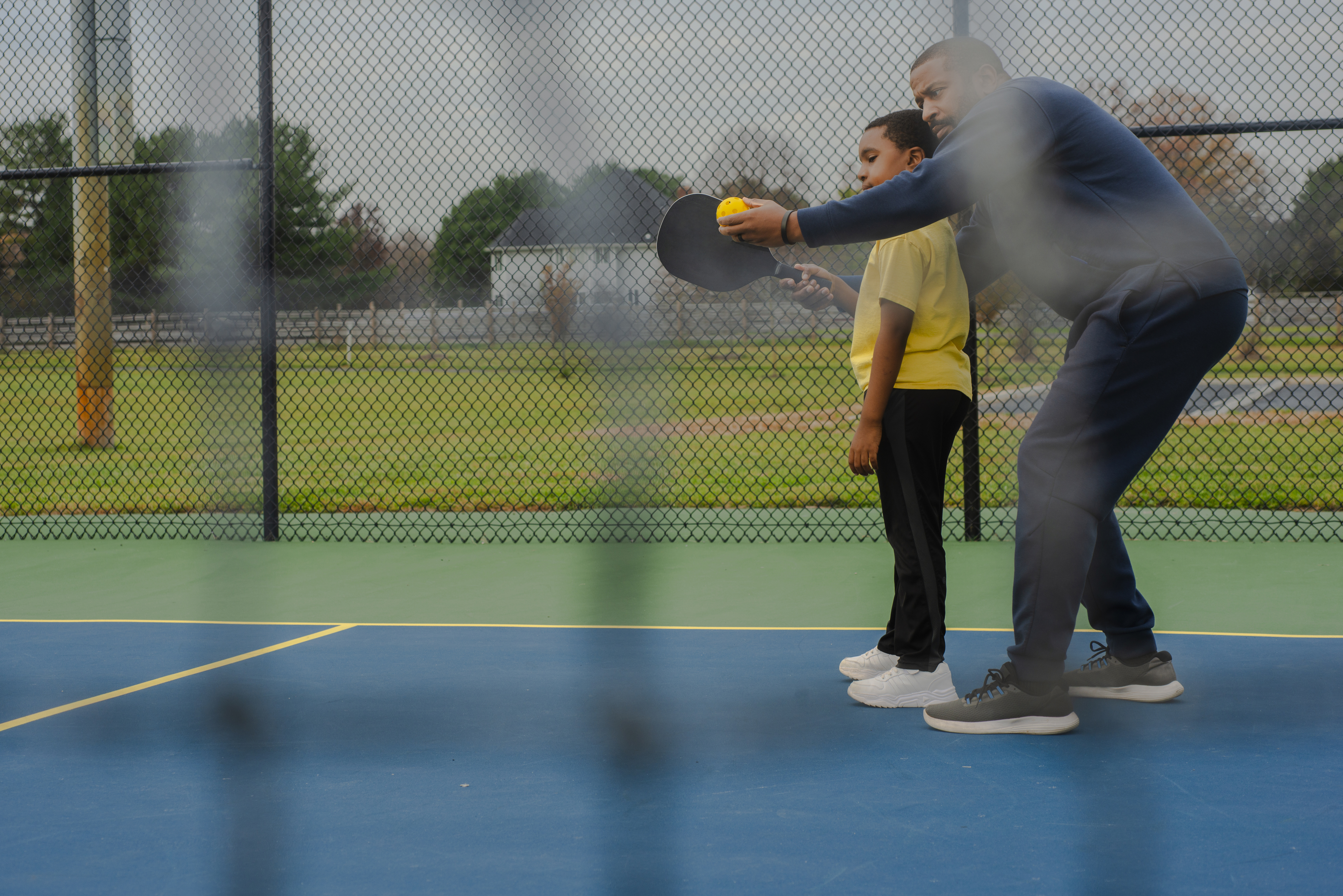
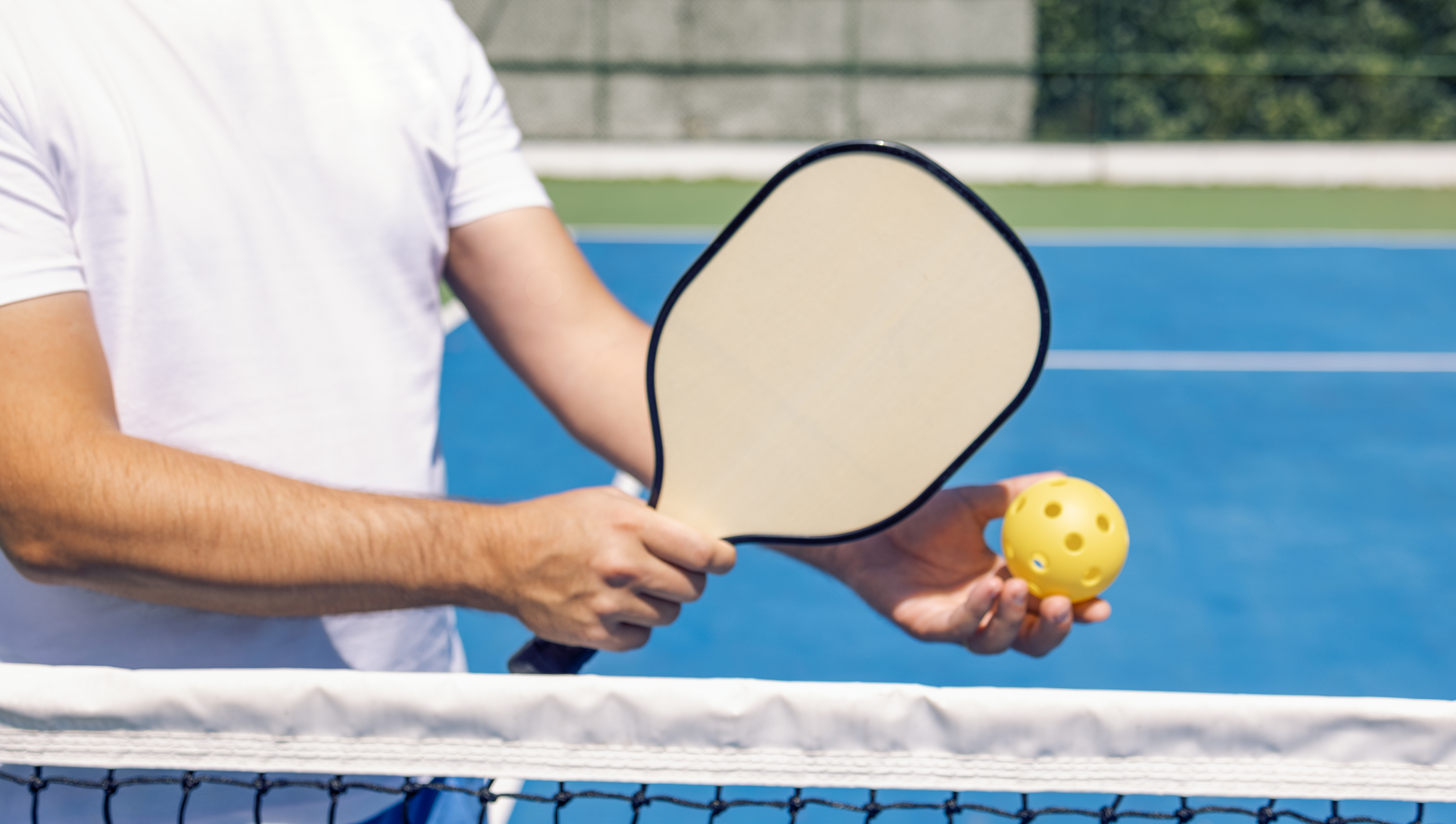
The finger test. Grab your paddle the way you’d grab it to hit a forehand. Slide the index finger of your non-dominant hand into the gap between your ring finger tips and the base of your thumb. If your index finger fits snugly into that gap, you’re good. If there’s extra room, your grip is too small. If your finger won’t fit, your grip is too big.
Here’s the brutal part: most paddles are sold with a 4.0” or 4.125” grip because smaller grips feel “snappier” on the showroom floor and let manufacturers appeal to the widest range of hand sizes. If your ring-finger measurement is 4.25” or 4.5” — and for a lot of adult men, it is — you’ve been playing with the wrong paddle this entire time. Yes, including that $200 flagship you bought at Christmas.
The Fix (Ranked by Effort and Expense)
You have three realistic options if your grip is too small. In order of cheap-and-dirty to nuclear:
1. Add an overgrip. An overgrip is a thin strip of tacky material you wrap around your existing grip. Each overgrip adds roughly 1/16” to your circumference. Want to go from a 4.0” to a 4.25”? Slap on four of them. Overgrips cost $3-8 each, take 90 seconds to install once you’ve done it a couple times, and are completely reversible. This is where almost everyone should start.
2. Replace the base grip. If you need more size than overgrips can reasonably add, or if you want different tack, cushion, or sweat absorption, pull off the factory grip and install a replacement. Cushioned replacement grips run thicker (adding up to 1/8”) and also dampen vibration, which your elbow will send you a thank-you card for.
3. Buy a paddle with the right grip from the jump. Some brands — Engage, ProKennex, a few Selkirk models — offer paddles in multiple grip sizes from the factory. If you’ve got bigger hands and you’re paddle shopping, filter by grip size, not just by power rating. It will save you more elbow pain than any amount of compression sleeves.
While We’re Here, About Your Grip Pressure
Correct grip size is only half the fight. The other half is how hard you’re squeezing.
The rule of thumb, borrowed from tennis and equally true in pickleball: grip pressure should be about 3 out of 10. Not flaccid. Not a death grip. Just enough to keep the paddle from flying out of your hand. If you can still wiggle the paddle a bit with your off-hand while you’re holding it, you’re in the zone.
Watch the pros next time you’re zoning out during a PPA broadcast. Their hands look relaxed. They’re not pre-tensing. The tension only spikes at contact, for a fraction of a second, and then the hand goes soft again. Most rec players carry a constant 7/10 death grip from serve to high-five, and their forearms are screaming by game four. You can fix this in one session just by paying attention to it. Seriously, try it.
The Paddle Stuff That Also Helps
After grip size and grip pressure, the remaining elbow-saving factors in roughly this order:
- Paddle weight. Heavier paddles (8.2 oz+) transfer less shock into your arm because they absorb more of the ball’s energy. Lighter paddles feel fast but send more vibration into your elbow. If you’re already hurting, get off the 7.4 oz feather paddles and try something in the 8.0-8.4 range.
- Vibration dampening. Foam-filled perimeters and edge-foam constructions kill the high-frequency buzz that irritates tendons. A Gen 3 or Gen 4 foam-core paddle is meaningfully gentler on the arm than a hollow cold-press from 2022.
- String — sorry, face texture. Overly aggressive gritty faces can subtly change your stroke because they grab the ball harder, which means you’ll unconsciously swing more aggressively to compensate. Not an elbow killer on its own, but a contributor.
The “Should I See a Doctor” Line
If you’ve had elbow pain for more than three weeks, if it hurts when you’re not playing, or if you feel weakness gripping everyday objects, stop trying to fix it with a new paddle and go see a physical therapist. Lateral epicondylitis responds well to eccentric strengthening (think slow wrist curls with a light weight), but it does not respond to “just push through it for one more tournament.” We’ve seen too many people turn a 2-week problem into a 2-year problem because they didn’t want to admit their elbow was cooked.
Measure your hand. Wrap your handle. Loosen your grip. Your elbow will stop yelling at you, and you’ll finally be able to blame your backhand for the right reasons.